

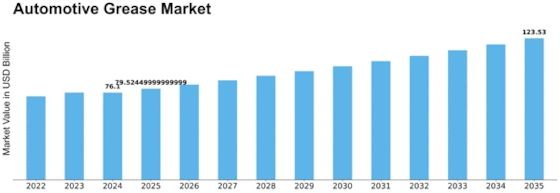
Automotive Grease Market Size Estimated at 76.1 USD Billion in 2024, Projected to Reach 123.53 USD Billion by 2035
Automotive Grease Market
North America remains the largest market for automotive grease, reflecting robust vehicle production and maintenance practices.
NEW YORK, NY, UNITED STATES, September 8, 2026 /EINPresswire.com/ -- According to Market Research Future, the Automotive Grease Market was estimated at 76.1 USD Billion in 2024. The industry is projected to grow from 79.53 USD Billion in 2025 to 123.53 USD Billion by 2035, exhibiting a compound annual growth rate (CAGR) of 4.5% during the forecast period 2025 - 2035. This steady growth trajectory reflects the indispensable role of lubricants in maintaining vehicle performance, durability, and efficiency across the global automotive parc, which continues to expand despite the accelerating transition toward electric mobility. The market's consistent expansion is underpinned by rising vehicle production in emerging economies, increasing average vehicle age in developed markets driving aftermarket demand, and the growing preference for high-performance synthetic lubricants that offer superior protection and extended service intervals.Market Overview
Automotive grease encompasses a wide range of lubricating products designed to reduce friction, protect against wear, prevent corrosion, and manage heat generation across various vehicle components. These products include engine oils, gear oils, transmission fluids, coolants, and specialized greases that serve critical functions in engines, transmissions, braking systems, chassis components, and wheel bearings. The market serves both original equipment manufacturer (OEM) requirements for factory-fill applications and the substantial aftermarket demand for routine maintenance and replacement across passenger vehicles, light commercial vehicles, and heavy commercial vehicles.
The growth drivers for the automotive grease market are diverse and interconnected. The continuous expansion of the global vehicle parc stands as the primary catalyst, with the worldwide vehicle population reaching unprecedented levels. Emerging economies, particularly in the Asia-Pacific region, are witnessing rapid motorization as rising incomes and urbanization drive vehicle ownership . China's motor-vehicle stock reached 453 million units, supported by 35.83 million new registrations in 2024, with new-energy vehicles (including EVs) surging 51.49% year-on-year . This growing vehicle population creates sustained demand for lubricants across both factory-fill and aftermarket channels.
The increasing average vehicle age in mature markets is another significant growth driver. Semiconductor shortages and inflation have slowed vehicle replacement rates in the United States, prompting owners to increase oil-change frequency and invest in higher-quality synthetic oils. Europe's fleet is even older, with average vehicle ages of 18.1 years in Western Europe and 28.4 years in Eastern Europe, driving more workshop visits and raising per-vehicle lubricant consumption . Older engines suffer seal degradation, thermal stress, and contamination, all of which accelerate oil degradation and spur demand for premium base stocks. Maintenance outlays for vehicles aged 6-15 years rose from USD 514 to USD 537 in just one year, underscoring the link between vehicle age and lubricant consumption .
Technological developments are reshaping the lubricant landscape at an accelerating pace. The shift toward lower-viscosity formulations, including ultra-low viscosity oils such as 0W-16 and 0W-12, enables OEMs to meet fleet-average CO2 targets, especially in Japan and Europe . Even within heavy-duty oils, the shift from 15W-40 to 5W-30 illustrates demand for thinner, high-HTHS blends that cut fuel costs. As viscosity grades narrow, additive packages diversify, with boron esters, molybdenum disulfide, and ashless detergents becoming cornerstones in next-generation formulations. The Automotive Lubricants Market continues to evolve as OEMs and lubricant suppliers collaborate to develop products that meet increasingly stringent performance and environmental standards.
The demand outlook for automotive grease remains robust, supported by the steady growth of the global vehicle parc, increasing average vehicle age in mature markets, and the continuous evolution of lubricant technology. The Automotive Engine Oil Market represents a significant segment within the broader lubricants landscape, with engine oil holding approximately 58.24% of 2025 volumes through ubiquitous use in spark-ignition and compression-ignition engines .
📍 Get Free Sample Report for Detailed Market Insights:
https://www.marketresearchfuture.com/sample_request/22090
Market Segmentation
The automotive grease market is segmented based on oil type, product type, and regional analysis to provide a comprehensive understanding of the industry landscape.
By Oil Type: The market is categorized into Synthetic, Semi-Synthetic, and Conventional (Mineral) oils. Synthetic oil grease has emerged as the dominant segment, gaining traction because it performs well in extreme heat, cold weather, and high-speed operations. Premium garages and fleet operators prefer it for longer service intervals, better oxidation resistance, and improved protection under demanding conditions . Synthetic oil grease held the largest share, accounting for approximately 56% of the market, driven by premium maintenance demand, EV applications, and high-performance vehicles . Semi-synthetic oils, representing a blend of mineral and synthetic base stocks, offer a balanced solution combining improved performance characteristics with moderate cost. Conventional mineral oil grease remains widely used because it is cost-effective, easily available, and suitable for many standard automotive lubrication needs, continuing to serve independent workshops, value-focused users, and older vehicle fleets . The shift toward synthetics is expected to accelerate as consumers seek extended protection, lower total cost of ownership, and improved fuel economy benefits.
By Product Type: The market is segmented into Engine Oil, Gear Oil, Transmission Fluids, Coolant, and Brake Fluid & Greases. Engine oil holds the largest market share through ubiquitous use in spark-ignition and compression-ignition engines, with larger sump capacities in light trucks and off-highway machinery amplifying its share . Transmission fluids, gear oils, and hydraulic oils serve narrower applications yet remain vital for manual transmissions, wet brakes, and power-steering circuits. Greases, while a fraction of the automotive lubricants market, are experiencing growth as electric vehicles require dedicated bearing greases that handle high RPM and electrical pitting . Suppliers blend synthetic esters and polyurea thickeners to deliver conductivity control and thermal stability, elevating product mix value. The segment's revenue mix swings toward synthetics as API SQ-compliant oils gain traction, with ultra-low viscosity formulations enabling OEMs to meet fleet-average CO2 targets.
By Region: The market analysis covers North America, Europe, Asia-Pacific, and Rest of the World. The Asia-Pacific region holds the largest market share, driven by high vehicle production, growing car ownership, expanding logistics fleets, and rapid urbanization . North America demonstrates strong demand for advanced lubrication technologies and eco-friendly products , while Europe is characterized by stringent environmental regulations leading to demand for low-toxicity and high-performance greases .
🛒 You can buy this market report at:
https://www.marketresearchfuture.com/checkout?currency=one_user-USD&report_id=22090
Regional Analysis
Asia-Pacific represents the largest and fastest-growing regional market for automotive grease, accounting for approximately 37% of global market share . The region's dominance is driven by high vehicle production, growing car ownership, and expanding logistics fleets. China leads the region as the world's largest automotive market, with vehicle production reaching 31.28 million units in 2024, including 12.88 million new-energy vehicles . Rapid urbanization and rising transport activity continue to increase grease consumption . India is emerging as a significant market, supported by loosened government regulations, initiatives like "Make in India," and a robust manufacturing center for the transportation sector . The availability of low-cost labor and decreased production expenses have bolstered India's emergence as a prominent market for automotive lubricants. The region's growth is further fueled by government subsidies and grants, robust economic growth, and increased automotive and construction activities .
North America remains a strong market for automotive grease, accounting for approximately 24% of global market share . The region's maturity is characterized by high vehicle ownership, long driving distances, and organized service chains. Around 44% of workshops recommend scheduled lubrication services for suspension and bearing systems . Demand for synthetic grease is rising as drivers keep vehicles longer and seek better protection. The United States is the region's largest producer of hydrocarbons and natural gas and the second-largest producer of automobiles, with high oil and gas production and processing contributing to substantial demand for automotive lubricants . Stringent environmental regulations enforced by regional governments will encourage vehicle manufacturers to invest substantially in R&D initiatives, with major automakers having invested billions in R&D to develop more efficient and environmentally friendly vehicles .
Europe is a mature market characterized by strong passenger vehicle ownership, premium car brands, and strict maintenance standards. The region accounted for approximately 25% of the global market . Nearly 39% of workshops in key markets prefer high-performance grease for wheel bearings and chassis parts . Electric vehicle growth is creating fresh demand for specialty lubrication solutions . The European automotive industry is facing significant transformation, with the region's commitment to reducing carbon emissions and promoting sustainable manufacturing practices influencing lubricant development. The European Green Deal and regulatory frameworks such as the Sustainable Urban Mobility Plan are driving investment in sustainable technologies and environmentally responsible products. The region's automotive industry is characterized by premium car brands that specify high-performance lubrication solutions, supporting demand for advanced synthetic and semi-synthetic greases.
Rest of the World, encompassing Latin America, the Middle East, and Africa, represents diverse markets with varying growth trajectories. The Middle East & Africa region accounts for approximately 14% of the global market and is growing steadily with increasing commercial transport, construction vehicles, and rising passenger car ownership . Harsh climate conditions create demand for durable grease with heat resistance. Service networks in urban centers are improving product access and replacement frequency . Latin America is experiencing steady growth driven by the rising demand for passenger and commercial vehicles . Infrastructure development and increasing automotive aftermarket activities are supporting market expansion across these regions .
Competitive Landscape and Key Players
The automotive grease market is characterized by intense competition, featuring a mix of established global lubricant manufacturers, regional blenders, and specialized product suppliers. Leading companies are focusing on strategic partnerships, technological innovation, capacity expansion, and portfolio diversification to strengthen their market positions. Competitive intensity remains moderate, with established players maintaining significant market share while regional blenders gain ground through local capacity additions and tailored formulations .
Key players operating in this space include major global lubricant manufacturers that leverage extensive distribution networks, strong brand recognition, and technical expertise to maintain dominant market positions. These industry leaders invest heavily in research and development to create advanced formulations that meet evolving OEM specifications and regulatory requirements. Regional blenders and specialized suppliers compete effectively in local markets through responsive customer service, regional formulation expertise, and competitive pricing.
Strategic developments are reshaping the competitive landscape. Major suppliers are collaborating with OEMs to develop co-engineered lubricant solutions optimized for specific vehicle platforms and operating conditions. Acquisitions and mergers are consolidating market presence, enabling companies to expand geographic coverage, access new customer segments, and achieve economies of scale in production and distribution. The shift toward synthetic formulations is driving investment in advanced base stock production capacity and additive chemistry development.
Latest Industry News and Developments
Recent industry developments reflect the dynamic nature of the automotive grease market. The accelerating adoption of electric vehicles is reshaping lubricant demand profiles, as EVs remove crankcase oils and many driveline fluids from service menus while introducing new niches for specialized fluids . The International Energy Agency projects global EV stock could eclipse 250 million by 2030, cutting oil demand by up to 4.3 million barrels per day, yet EVs introduce new opportunities for esters for e-motor bearings, dielectric coolants, and gear greases optimized for electric powertrains . For lubricant suppliers, the challenge shifts from volume to value as specialized fluids command two-to-three-fold price premiums over conventional engine oil .
The automotive industry continues to witness increasing adoption of sustainable manufacturing practices and materials. European regulators are tightening emissions standards and promoting circular economy approaches, influencing lubricant development and marketing strategies. Major automakers are investing billions in research and development to create more efficient vehicles and reduce carbon footprints, with these R&D initiatives creating opportunities for advanced lubricant formulations .
The lubricant industry is responding to the growing demand for extended service intervals by developing synthetic formulations with improved oxidation resistance and thermal stability. These innovations are supporting the trend toward longer oil change intervals, reducing maintenance costs and environmental impact while improving vehicle reliability.
Market Challenges and Opportunities
The automotive grease market faces several challenges that could impact growth trajectories. The accelerating penetration of electric vehicles represents the most significant structural challenge, as EVs require less frequent lubrication and eliminate engine oil entirely from the maintenance regimen . However, this challenge is partially offset by the higher value of specialized EV lubricants and the continued growth of the conventional vehicle parc in emerging markets. OEM-specified long-drain intervals are also impacting volume growth, as vehicles require oil changes less frequently .
Raw material price volatility and supply chain disruptions continue to present operational challenges for lubricant manufacturers. Fluctuations in crude oil prices, additive costs, and logistics expenses can compress profit margins and complicate pricing strategies. The cost of production is high as complex processes are involved in producing finished products, posing challenges for manufacturers to offer competitively priced products .
Emerging opportunities are abundant in the evolving market landscape. The growing vehicle parc in emerging economies, particularly in Asia-Pacific and Latin America, presents substantial opportunities for volume growth . The shift toward premium synthetic lubricants offers margin expansion opportunities, as higher-value synthetics now dominate service bays as owners seek extended protection and lower total cost of ownership . Electric vehicles introduce new niches for specialized fluids, including esters for e-motor bearings, dielectric coolants, and gear greases optimized for high RPM and electromagnetic compatibility .
To explore more market insights, visit us at:
https://www.marketresearchfuture.com/reports/automotive-grease-market-22090
Final Market Summary
Key factors expected to influence future development include the pace of electric vehicle adoption, the evolution of emissions regulations, and the development of advanced lubricant formulations capable of meeting increasingly stringent performance and environmental standards. Consumer preferences for extended protection, lower total cost of ownership, and environmentally responsible products will continue to drive innovation across all lubricant segments. The ongoing digitalization of vehicle maintenance and the integration of predictive analytics will create new opportunities for service differentiation and customer engagement.
The transition toward sustainable mobility represents a fundamental shift in the automotive industry, positioning lubricant suppliers as essential partners in optimizing vehicle performance, efficiency, and reliability. As vehicles continue to evolve toward more efficient and sustainable propulsion systems, the importance of advanced lubricant solutions that protect critical components, enhance efficiency, and reduce environmental impact will only continue to grow, ensuring sustained demand throughout the forecast period and beyond.
More Related Reports from MRFR Library:
Automotive Tow Bar Market : https://www.marketresearchfuture.com/reports/automotive-tow-bar-market-10092
Automotive Exterior Smart Lighting Market : https://www.marketresearchfuture.com/reports/automotive-exterior-smart-lighting-market-10094
Automotive Windshield Washer Market : https://www.marketresearchfuture.com/reports/automotive-windshield-washer-market-10172
Aircraft Component MRO Market : https://www.marketresearchfuture.com/reports/aircraft-component-mro-market-1665
Automotive E tailing Market : https://www.marketresearchfuture.com/reports/automotive-e-tailing-market-1915
Automotive Robotics Market : https://www.marketresearchfuture.com/reports/automotive-robotics-market-1989
Automotive Front End Module Market : https://www.marketresearchfuture.com/reports/automotive-front-end-module-market-2016
Automotive Intercooler Market : https://www.marketresearchfuture.com/reports/automotive-intercooler-market-2094
Automotive Actuators Market : https://www.marketresearchfuture.com/reports/automotive-actuators-market-2126
Automotive Fuel Delivery System Market : https://www.marketresearchfuture.com/reports/automotive-fuel-delivery-system-market-2193
Market Research Future
Market Research Future
+1 855-661-4441
email us here
Legal Disclaimer:
EIN Presswire provides this news content "as is" without warranty of any kind. We do not accept any responsibility or liability for the accuracy, content, images, videos, licenses, completeness, legality, or reliability of the information contained in this article. If you have any complaints or copyright issues related to this article, kindly contact the author above.
