

Automotive Infotainment Market to Reach USD 78.65 Billion by 2035, Growing at 8.51% CAGR
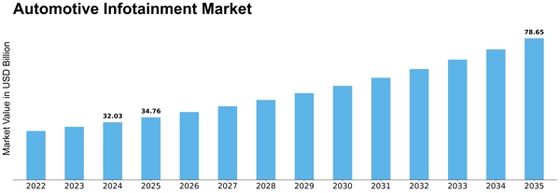
Automotive Infotainment Market
North America remains the largest market for automotive infotainment, characterized by a strong demand for advanced connectivity features.
NEW YORK, NY, UNITED STATES, September 8, 2026 /EINPresswire.com/ -- According to Market Research Future, the Automotive Infotainment Market is projected to reach USD 78.65 Billion, with a CAGR of 8.51% by 2035. This robust growth trajectory reflects the automotive industry's rapid transformation, where infotainment systems have evolved from basic audio and navigation units into comprehensive digital ecosystems that define the modern driving experience. The market's consistent expansion is underpinned by the convergence of advanced connectivity, artificial intelligence, and consumer demand for seamless, personalized in-vehicle experiences that rival smartphone functionality and home entertainment systems.Market Overview
Automotive infotainment systems represent the integrated hardware and software platforms that deliver entertainment, information, navigation, and connectivity services to vehicle occupants. These systems encompass touchscreen displays, voice recognition interfaces, smartphone integration platforms, navigation modules, audio systems, and advanced connectivity solutions that transform vehicles into connected digital hubs. The market spans both original equipment manufacturer installations and aftermarket solutions, serving passenger cars, light commercial vehicles, and heavy commercial vehicles across global markets.
The growth drivers for the automotive infotainment market are diverse and mutually reinforcing. Increasing consumer demand for seamless connectivity stands as the primary catalyst, as vehicle occupants expect uninterrupted access to smartphones, streaming services, and cloud-based applications while on the move. The proliferation of 5G technology and Internet of Things connectivity has enabled real-time data processing, over-the-air updates, and enhanced infotainment capabilities that were previously impossible.
The rapid adoption of electric vehicles is accelerating market expansion, as EV manufacturers leverage advanced infotainment systems to differentiate their offerings and provide comprehensive vehicle management interfaces. Electric vehicles require intelligent displays for battery monitoring, range estimation, and charging station integration, creating substantial opportunities for infotainment system developers. The shift toward autonomous driving further expands the possibilities for infotainment innovation, as vehicles increasingly become mobile living and working spaces where entertainment and productivity take precedence over driving tasks.
Technological developments are reshaping the infotainment landscape at an accelerating pace. Artificial intelligence and machine learning algorithms are being embedded into systems to enable natural language voice recognition, gesture control, predictive personalization, and contextually aware recommendations. Augmented reality navigation is emerging as a transformative technology, overlaying directional information onto real-world views through head-up displays and windshield projections. The integration of advanced driver assistance system data with infotainment platforms is enabling safety-enhancing features that keep drivers informed without causing distraction.
Policy and regulatory influences are shaping market dynamics significantly. Governments worldwide are implementing stringent hands-free communication requirements and driver distraction regulations that mandate specific design and functionality standards for infotainment systems. Data privacy and cybersecurity regulations are influencing the architecture of connected infotainment platforms, requiring robust security measures to protect user data and vehicle systems from potential threats.
The demand outlook for automotive infotainment remains exceptionally strong, driven by the increasing digitalization of vehicles and the growing convergence of automotive, consumer electronics, and telecommunications technologies. As vehicles become more connected and autonomous, the importance of sophisticated infotainment solutions will only continue to grow, ensuring sustained demand across all vehicle segments.
📍 Get Free Sample Report for Detailed Market Insights:
https://www.marketresearchfuture.com/sample_request/3993
Market Segmentation
The automotive infotainment market is segmented based on operating system and regional analysis to provide a comprehensive understanding of the industry landscape.
By Operating System: The market is categorized into QNX, Linux, Microsoft, and Others. QNX has established a dominant position in the automotive infotainment space, particularly among premium and luxury vehicle manufacturers, due to its proven reliability, real-time performance capabilities, and robust security features. The operating system's ability to support complex multimedia applications while maintaining system stability has made it the preferred choice for mission-critical infotainment platforms. BlackBerry QNX continues to demonstrate strong adoption across major automotive OEMs, with the embedded software platform being featured in over 215 million vehicles globally.
Linux has emerged as a significant contender, particularly in the electric vehicle segment, driven by its open-source architecture, cost-effectiveness, and flexibility for customization. The In-Car Infotainment Market is benefiting from the increasing preference for Linux-based platforms among EV manufacturers and technology-oriented brands, as Linux enables faster innovation cycles and over-the-air update capabilities. Major automakers such as Tesla and several Chinese EV manufacturers have adopted Linux-based infotainment platforms, demonstrating the operating system's viability for high-performance, consumer-focused applications. The Linux ecosystem is expected to witness faster growth compared to proprietary systems, supported by the expanding developer community and the increasing demand for customizability in software-defined vehicle platforms.
Microsoft continues to maintain a presence in the automotive infotainment market, leveraging its expertise in cloud computing, enterprise software, and developer tools. The company's Azure cloud platform is increasingly integrated with automotive infotainment systems, enabling connected vehicle services and data analytics. Microsoft's automotive strategy emphasizes partnerships rather than direct operating system competition, focusing on providing development tools and cloud services that support automakers in building their own digital cockpit platforms. Other operating systems, including Android Automotive OS and various proprietary platforms, contribute to market diversity and offer automakers alternative solutions that align with specific product strategies and regional preferences.
By Region: The market analysis covers North America, Europe, Asia-Pacific, and Rest of the World. Asia-Pacific emerges as the fastest-growing regional market, driven by massive automotive production in China, India, Japan, and South Korea, coupled with rapid technological adoption and expanding consumer spending on vehicle features. North America currently dominates the global market, valued at USD 10.81 billion in 2021, driven by strong AI adoption, advanced digital infrastructure, and high corporate investment in vehicle technology.
🛒 You can buy this market report at:
https://www.marketresearchfuture.com/checkout?currency=one_user-USD&report_id=3993
Regional Analysis
North America holds a prominent position in the automotive infotainment market, characterized by high consumer expectations for advanced connectivity and entertainment features. The United States leads regional demand, driven by widespread integration of connected technologies, strong consumer preference for smartphone integration platforms, and high levels of corporate investment in automotive technology innovation. The region's robust regulatory framework regarding driver safety and hands-free communication has accelerated the adoption of voice-controlled and gesture-based infotainment interfaces. Canadian and Mexican markets continue to grow, supported by increasing vehicle production and the expansion of automotive manufacturing capabilities under trade agreements that facilitate regional supply chain integration.
Europe represents a mature and technologically advanced market, characterized by early adoption of digital cockpit technologies and strong emphasis on automotive innovation and design excellence. Germany leads regional consumption with its dominant automotive industry, where premium brands specify sophisticated infotainment systems as standard equipment. French and Italian manufacturers focus on compact and design-led solutions, while the European Union's stringent environmental and safety regulations drive innovation in energy-efficient infotainment hardware and distraction-minimizing interfaces. The region's commitment to carbon neutrality is influencing the development of sustainable infotainment solutions with reduced power consumption and recyclable materials.
Asia-Pacific emerges as the fastest-growing regional market, fueled by massive automotive production capabilities, rapid urbanization, and expanding middle-class populations with increasing disposable incomes. China leads the region as the world's largest automotive market and a hub for electric vehicle innovation, with aggressive government initiatives promoting intelligent connected vehicles creating substantial demand for advanced infotainment solutions. Japanese and Korean manufacturers continue to push technological boundaries, introducing innovative infotainment systems with advanced human-machine interfaces and seamless smartphone integration. India is witnessing significant market growth as consumer awareness and disposable incomes increase, driving demand for feature-rich infotainment systems in passenger vehicles.
Rest of the World, encompassing Latin America, the Middle East, and Africa, represents diverse markets with varying growth trajectories. Latin American markets show steady growth supported by recovering vehicle production and increasing consumer demand for modern vehicle features. The Middle East, particularly GCC countries, demonstrates strong demand for premium vehicles equipped with state-of-the-art infotainment systems. African markets remain at nascent stages but hold potential as automotive infrastructure develops and vehicle ownership rates increase.
Competitive Landscape and Key Players
The automotive infotainment market is highly competitive, featuring a mix of established automotive suppliers, technology giants, and emerging players competing for market share. Leading companies are focusing on strategic partnerships, technological innovation, software development, and ecosystem expansion to strengthen their market positions.
Key players operating in this space include Bosch (DE), Denso (JP), Continental (DE), Harman International (US), Pioneer (JP), Panasonic (JP), Visteon Corporation, and Alpine Electronics. These industry leaders leverage their extensive manufacturing capabilities, global footprints, and strong relationships with major automotive OEMs to maintain dominant market positions. The In-car Audio System Market is increasingly integrated with infotainment platforms, as leading audio brands including Bose, Bang & Olufsen, and Sony collaborate with infotainment providers to deliver premium sound experiences that complement advanced display and connectivity features.
Strategic developments are reshaping the competitive landscape. Major suppliers are forming collaborations with technology companies to integrate artificial intelligence, cloud computing, and connectivity solutions into infotainment platforms. Partnerships with Google, Apple, Amazon, and Microsoft are enabling enhanced voice recognition, cloud-based services, and seamless smartphone integration. Acquisitions and mergers are consolidating expertise in software development, user experience design, and connectivity technologies, enabling comprehensive infotainment solutions that meet evolving industry requirements.
Innovation and technology initiatives are accelerating across the industry. Companies are developing centralized domain controllers that consolidate multiple electronic control units, reducing system complexity and cost while improving performance. The integration of artificial intelligence for predictive personalization and natural language processing is becoming a key differentiator, enabling infotainment systems that learn from driver behavior and preferences. Advanced display technologies, including curved OLED screens, pillar-to-pillar displays, and augmented reality head-up displays, are redefining the visual landscape of vehicle cabins.
Sustainability has emerged as a critical competitive differentiator. Leading manufacturers are exploring eco-friendly materials, energy-efficient hardware, and sustainable production processes to meet growing consumer and regulatory expectations. Companies that successfully combine technological innovation with environmental responsibility are better positioned to capture long-term market value.
Latest Industry News and Developments
Recent industry developments reflect the dynamic nature of the automotive infotainment market. Visteon Corporation reported strong financial performance in the second quarter, with net sales of USD 1,014 million, driven by the robust performance of its electrification and digital cockpit products. The company's gross margin reached USD 147 million, with adjusted EBITDA reaching a record USD 136 million, representing a USD 46 million increase from the previous year. Visteon's sales exceeded customer car production volumes by nine percent, reflecting strong market demand for advanced infotainment solutions.
Volkswagen Group continues to execute its "NEW AUTO - Mobility for Generations to Come" Group strategy, laying the groundwork for significant transformation in the automotive industry. The company's focus on autonomous and connected driving is fundamentally altering customer mobility experiences and paving the way for new data-based revenue models, including subscription-based infotainment services and over-the-air feature upgrades. Volkswagen's strategy alignment and performance programs across all brands are designed to boost profitability while maintaining innovation momentum.
General Motors has expanded charging access to the Tesla Supercharger Network, strengthening its commitment to a unified charging standard for electric vehicles. This strategic move enhances the EV ownership experience, which in turn supports the adoption of advanced infotainment systems that provide comprehensive charging management and navigation features.
Market Challenges and Opportunities
The automotive infotainment market faces several challenges that could impact growth trajectories. Technological complexity presents significant challenges, as the integration of multiple operating systems, connectivity protocols, and user interfaces requires substantial investment in research and development and engineering resources. Cybersecurity concerns pose a critical challenge as vehicles become more connected, requiring robust security measures to protect occupant data and vehicle systems from potential hacking and data breaches. The automotive industry must maintain transparency regarding data collection practices and comply with evolving regulatory frameworks regarding data privacy and protection.
Supply chain disruptions, exacerbated by semiconductor shortages and geopolitical tensions, continue to challenge production schedules and inventory management. The complexity of global supply chains for electronic components and software development resources emphasizes the need for diversified sourcing strategies and increased localization of manufacturing capabilities.
Regulatory compliance across different regions adds another layer of complexity, requiring manufacturers to develop adaptable solutions that meet diverse safety, connectivity, and data privacy standards. Data privacy and cybersecurity regulations are influencing the architecture of connected infotainment platforms, requiring robust security measures to protect user data and vehicle systems.
Emerging opportunities are abundant in the evolving market landscape. The transition toward electric vehicles presents significant growth potential, as EVs require specialized infotainment solutions that support battery management, range estimation, and charging infrastructure integration. The development of subscription-based content services for personalized user experiences represents a significant revenue opportunity for infotainment providers. Strategic partnerships with technology firms to innovate in voice recognition and AI-driven interfaces are creating new possibilities for differentiated user experiences.
The integration of advanced driver-assistance systems with infotainment platforms is creating opportunities for safety-enhancing features that keep drivers informed without causing distraction. The development of augmented reality navigation systems, AI-powered virtual assistants, and predictive personalization features represents key areas of innovation that are reshaping the infotainment landscape.
Future growth potential remains exceptionally strong, driven by the increasing digitalization of vehicles and the convergence of automotive, consumer electronics, and telecommunications technologies. As autonomous driving capabilities advance, infotainment systems will transform into comprehensive digital environments that support work, entertainment, and relaxation, creating unprecedented opportunities for innovative solutions and collaborative partnerships.
To explore more market insights, visit us at:
https://www.marketresearchfuture.com/reports/automotive-infotainment-market-3993
Final Market Summary
The automotive infotainment market is poised for remarkable growth, driven by technological innovation, changing consumer expectations, and the transformation of vehicles toward connected, electrified, and autonomous platforms. The market's progression toward USD 78.65 Billion by 2035 reflects the increasing importance of infotainment systems as critical differentiators and revenue generators for automakers.
The long-term industry potential remains exceptionally promising, with advancements in artificial intelligence, connectivity, and display technologies continuing to expand the possibilities for in-vehicle experiences. The convergence of automotive, consumer electronics, and technology sectors is enabling unprecedented levels of personalization, connectivity, and convenience, making infotainment a central element of the vehicle value proposition.
Key factors expected to influence future development include the pace of electric vehicle adoption, advancements in autonomous driving technologies, and the evolution of connectivity standards. Regulatory developments regarding data privacy, cybersecurity, and driver safety will continue to shape product development strategies and user interface designs. Consumer preferences for intuitive, connected, and personalized infotainment experiences will drive innovation across all vehicle segments.
The transition toward software-defined vehicles represents a fundamental shift in the industry, positioning infotainment systems as critical platforms for continuous innovation and service delivery. As vehicles increasingly become digital ecosystems, the importance of sophisticated infotainment solutions will only continue to grow, ensuring robust demand and market expansion throughout the forecast period and beyond.
More Related Reports from MRFR Library:
Automotive Heat Shield Market : https://www.marketresearchfuture.com/reports/automotive-heat-shield-market-6174
Automotive Constant Velocity Joint Market : https://www.marketresearchfuture.com/reports/automotive-constant-velocity-joint-market-6224
Automotive Active Body Panel Market : https://www.marketresearchfuture.com/reports/automotive-active-body-panel-market-6253
Automotive Advanced Shifter System Market : https://www.marketresearchfuture.com/reports/automotive-advanced-shifter-system-market-6257
Automotive Active Purge Pump Market : https://www.marketresearchfuture.com/reports/automotive-active-purge-pump-market-6258
Automotive Automatic Tire Inflation System Market : https://www.marketresearchfuture.com/reports/automotive-automatic-tire-inflation-system-market-6259
Automotive Air Deflector Market : https://www.marketresearchfuture.com/reports/automotive-air-deflector-market-6265
Automotive Flex Fuel Engine Market : https://www.marketresearchfuture.com/reports/automotive-flex-fuel-engine-market-6270
Automotive Intelligent Door System Market : https://www.marketresearchfuture.com/reports/automotive-intelligent-door-system-market-6271
Diesel Particulate Filter Market : https://www.marketresearchfuture.com/reports/diesel-particulate-filter-market-6274
Market Research Future
Market Research Future
+1 855-661-4441
email us here
Legal Disclaimer:
EIN Presswire provides this news content "as is" without warranty of any kind. We do not accept any responsibility or liability for the accuracy, content, images, videos, licenses, completeness, legality, or reliability of the information contained in this article. If you have any complaints or copyright issues related to this article, kindly contact the author above.
