

Embedded Security Market to Reach US$ 15.4 Billion by 2033 Driven by IoT and Cybersecurity Growth
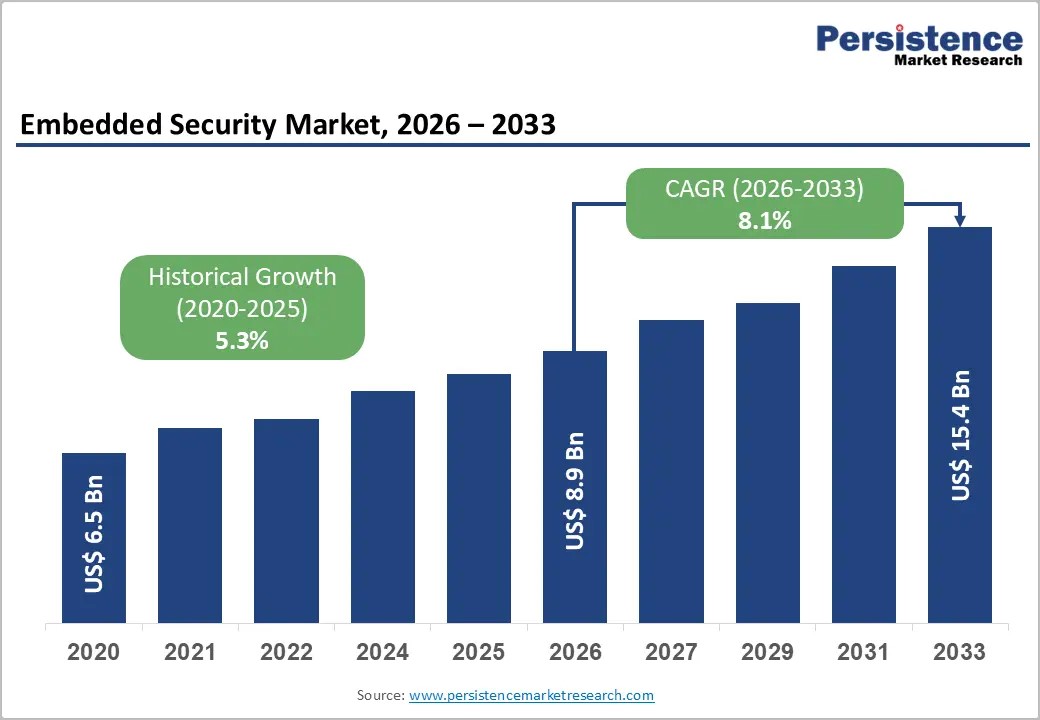
The embedded security market will rise from US$8.9 Billion in 2026 to US$15.4 Billion by 2033, growing globally at a CAGR of 8.1%
PUNE, MAHARASHTRA, INDIA, July 21, 2026 /EINPresswire.com/ -- The global embedded security market is projected to grow from US$ 8.9 billion in 2026 to US$ 15.4 billion by 2033, expanding at a CAGR of 8.1% due to rising cyber threats, IoT adoption, connected vehicles, and smart device growth. Increasing demand for hardware-rooted security solutions such as secure elements, TPMs, and HSMs, along with strict cybersecurity regulations, is accelerating market expansion. Hardware leads with over 56% share, while payment security dominates applications with over 28% share. Asia Pacific holds the largest market share of over 40%, supported by semiconductor manufacturing, electronics production, and digital transformation initiatives.
𝐆𝐞𝐭 𝐚 𝐒𝐚𝐦𝐩𝐥𝐞 𝐏𝐃𝐅 𝐁𝐫𝐨𝐜𝐡𝐮𝐫𝐞 𝐨𝐟 𝐭𝐡𝐞 𝐑𝐞𝐩𝐨𝐫𝐭: https://www.persistencemarketresearch.com/samples/21511
Embedded Security Market Segmentation Analysis
The embedded security market can be segmented based on components, applications, and end-user industries. Based on components, the market is divided into hardware and software solutions. Hardware currently represents the largest segment due to the growing need for secure physical foundations that protect sensitive data and device identities. Secure elements, TPMs, HSMs, and secure microcontrollers provide tamper-resistant environments that support authentication, encryption, and secure communication. These solutions are increasingly integrated into IoT gateways, automotive systems, payment devices, and industrial equipment.
The software segment is expanding rapidly as connected ecosystems require continuous protection throughout the product lifecycle. Embedded security software solutions enable secure firmware updates, vulnerability management, trusted execution environments, remote device monitoring, and lifecycle-based security controls. The increasing complexity of connected systems is encouraging manufacturers to combine hardware protection with software-based security platforms.
Based on applications, payment security represents the leading segment due to the increasing adoption of digital transactions and regulatory compliance requirements. Payment terminals, smart cards, wearable payment devices, and mobile wallets rely on embedded security technologies to protect financial credentials and prevent unauthorized access. Authentication and identity management is emerging as a high-growth application as organizations adopt digital identity platforms, biometric authentication, and zero-trust security models.
By vertical, consumer electronics remains the largest segment, supported by increasing demand for smartphones, smart home devices, wearables, and connected entertainment systems. Manufacturers are integrating secure boot, trusted execution environments, and encryption technologies to protect consumer data and enhance device reliability. Automotive is expected to register the fastest growth as vehicles become increasingly software-driven and connected through advanced driver assistance systems (ADAS), vehicle-to-everything (V2X) communication, and over-the-air updates.
Regional Insights of the Embedded Security Market
Asia Pacific represents the largest and fastest-growing region in the embedded security market, accounting for more than 40% of global revenue in 2026. The region benefits from strong semiconductor manufacturing capabilities, a large electronics production ecosystem, and increasing government initiatives focused on cybersecurity and digital infrastructure. China leads the regional market due to its dominance in consumer electronics and electric vehicle manufacturing, along with national security standards such as GB/T embedded security requirements and MLPS 2.0 regulations.
India is emerging as one of the fastest-growing markets in Asia Pacific due to rapid digital transformation initiatives, including Aadhaar-based identity systems, UPI payment infrastructure, and smart city development. Government programs such as the Semiconductor Mission and Production Linked Incentive (PLI) schemes are supporting domestic electronics manufacturing and increasing demand for embedded security solutions.
North America holds a significant position in the global market, accounting for more than 26% share in 2026. Growth in the region is supported by advanced semiconductor development, cybersecurity regulations, cloud infrastructure expansion, and government security initiatives. The United States represents the majority of the regional market due to strong demand from defense, financial services, automotive, and technology companies. Federal cybersecurity initiatives, including NIST framework adoption and software supply chain security requirements, are strengthening embedded security adoption.
Europe is another important market, accounting for over 20% share in 2026. The region’s growth is driven by strict cybersecurity regulations, including the EU Cyber Resilience Act and NIS2 Directive. Germany leads the European market due to its automotive manufacturing base, industrial automation sector, and advanced cybersecurity certification ecosystem. The United Kingdom is also witnessing strong demand due to financial technology growth and increasing adoption of hardware-backed authentication systems.
𝐃𝐨 𝐘𝐨𝐮 𝐇𝐚𝐯𝐞 𝐀𝐧𝐲 𝐐𝐮𝐞𝐫𝐲 𝐎𝐫 𝐒𝐩𝐞𝐜𝐢𝐟𝐢𝐜 𝐑𝐞𝐪𝐮𝐢𝐫𝐞𝐦𝐞𝐧𝐭? 𝐑𝐞𝐪𝐮𝐞𝐬𝐭 𝐂𝐮𝐬𝐭𝐨𝐦𝐢𝐳𝐚𝐭𝐢𝐨𝐧 𝐨𝐟 𝐑𝐞𝐩𝐨𝐫𝐭: https://www.persistencemarketresearch.com/request-customization/21511
Market Drivers Supporting Embedded Security Growth
The rapid growth of IoT, connected devices, and smart infrastructure is driving demand for embedded security solutions. Organizations are adopting hardware-based protection, including secure elements, TPMs, and HSMs, to safeguard devices against advanced cyber threats. Rising regulatory requirements and automotive cybersecurity standards are further accelerating adoption across industries.
Market Restraints Affecting Industry Expansion
High integration costs and technical complexity remain key challenges for embedded security adoption, especially in low-power and cost-sensitive devices. Additionally, fragmented cybersecurity standards increase compliance costs and create barriers for global manufacturers.
Market Opportunities Creating Future Growth Potential
The shift toward post-quantum cryptography and growing adoption of connected vehicles present major opportunities for embedded security providers. Increasing demand for secure automotive chips, electric vehicles, and software-defined vehicle architectures is expected to create new growth avenues through 2033.
𝐁𝐮𝐲 𝐍𝐨𝐰 𝐭𝐡𝐞 𝐃𝐞𝐭𝐚𝐢𝐥𝐞𝐝 𝐑𝐞𝐩𝐨𝐫𝐭: https://www.persistencemarketresearch.com/checkout/21511
Company Insights
The embedded security market is moderately consolidated, with leading semiconductor companies and cybersecurity providers focusing on hardware-based protection, secure platforms, and lifecycle security services.
Key players operating in the embedded security market include:
• Infineon Technologies
• NXP Semiconductors
• STMicroelectronics
• Microchip Technology
• Renesas Electronics
• Texas Instruments
• Samsung Electronics
• Broadcom
• Qualcomm
• Nuvoton Technology
• Thales Group
• IBM
Conclusion
The embedded security market is entering a period of sustained expansion as digital transformation, IoT proliferation, connected vehicles, and cybersecurity regulations reshape how organizations protect devices and data. Hardware-based security solutions remain central to market growth as industries increasingly recognize the importance of establishing trust at the device level. While integration complexity and fragmented standards present challenges, opportunities created by post-quantum cryptography, automotive cybersecurity, and smart connected ecosystems are expected to generate significant growth potential. With Asia Pacific leading global adoption and major technology companies investing in secure semiconductor platforms, the embedded security industry is positioned for steady advancement through 2033.
Related Reports:
Virtual Desktop Infrastructure Market
Digital Experience Platform Market
Pooja Gawai
Persistence Market Research
+1 646-878-6329
email us here
Visit us on social media:
LinkedIn
Instagram
Facebook
YouTube
X
Legal Disclaimer:
EIN Presswire provides this news content "as is" without warranty of any kind. We do not accept any responsibility or liability for the accuracy, content, images, videos, licenses, completeness, legality, or reliability of the information contained in this article. If you have any complaints or copyright issues related to this article, kindly contact the author above.
