

Aircraft Cabin Environment Sensor Market Report 2036: Trends, Sustainability Drivers & Competitive Positioning
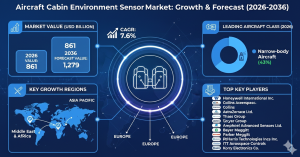
Aircraft Cabin Environment Sensor Market grows as airlines adopt real-time air quality monitoring to enhance passenger comfort, safety, and cabin efficiency
ROCKVILLE, MD, UNITED STATES, January 28, 2026 /EINPresswire.com/ -- As the global aviation industry pivots toward hyper-efficient, data-centric operations, the Aircraft Cabin Environment Sensor Market has emerged as a critical vertical for investment. In 2026, the sector is no longer defined by simple hardware sales but by the high-value data streams these sensors generate.Recent quantitative analysis reveals that the transition from analog to digital sensing is driving a market valuation surge, with the broader aircraft sensor ecosystem reaching USD 861 million this year. This growth is underpinned by a 4.6% CAGR, a figure bolstered by the rapid integration of Internet of Things (IoT) protocols within the fuselage.
Request for Sample Report | Customize Report |purchase Full Report - https://www.factmr.com/connectus/sample?flag=S&rep_id=13879
Quantifying the Shift: Key Market Metrics
The transition toward advanced sensing technology is clearly reflected in the 2026 market metrics, which show a diverse adoption rate across various aviation segments. Commercial Aviation maintains the largest presence in the sector, commanding a 62% market share. This dominance is primarily driven by the large-scale integration of HEPA-integrated sensor suites designed to meet rigorous public health and air quality standards.
The Business and Private Jet segment follows with a 21% share, where growth is fueled by a demand for bespoke "Wellness Cabins" equipped with sophisticated Volatile Organic Compound (VOC) monitoring. Meanwhile, Military and Defense accounts for 12% of the market, focusing on mission-critical, specialized life-support monitoring essential for high-altitude operations. Finally, the emerging General and Advanced Mobility sector holds a 5% share, with its growth trajectory tied to essential thermal management systems for eVTOL battery safety and cabin integrity.
The Cost of Air Quality: Why Data Matters
For airline operators, the financial incentive for advanced sensing goes beyond passenger comfort. Data-driven environmental control systems (ECS) are proven to reduce operational overhead:
Fuel Efficiency: Next-generation sensors allow for "Demand-Based Ventilation." By precisely measuring $CO_{2}$ levels, systems can adjust intake airflow, potentially reducing fuel burn related to the ECS by up to 1.5% to 2% annually.
Predictive Maintenance: Sensors monitoring pressure differentials and humidity levels can predict seal failures or duct blockages with 85% accuracy before a mechanical failure occurs, preventing costly "Aircraft on Ground" (AOG) events.
Regulatory Compliance: With the FAA and EASA implementing stricter reporting requirements for cabin air quality, automated data logging from digital sensors reduces the administrative burden on flight crews by 30%.
Technological Benchmarks in 2026
The market is currently being reshaped by Micro-Electro-Mechanical Systems (MEMS) technology. These sensors offer a significant reduction in footprint compared to legacy systems:
Weight Reduction: Moving from traditional sensors to MEMS-based wireless nodes reduces cabin wiring weight by approximately 40–60 kg per wide-body aircraft.
Response Time: Modern electrochemical sensors now boast a $T_{90}$ response time (the time taken to reach 90% of a step change in concentration) of less than 15 seconds for hazardous gas detection.
Regional Growth Projections (2025–2030)
While North America remains the primary hub for sensor innovation and OEM integration (holding 38% of the global market), the Asia-Pacific region is experiencing the highest volume of new installations. This is largely due to a projected delivery of over 8,500 new aircraft in the region over the next decade, nearly all of which feature advanced, multi-parameter cabin environment suites as standard equipment.
"The industry is moving past basic telemetry," says a lead market analyst. "In 2026, the value lies in 'Edge Intelligence'—sensors that don't just report data, but analyze it locally to provide actionable insights for the flight deck and ground crews simultaneously."
Summary of Strategic Outlook
The Aircraft Cabin Environment Sensor Market is transitioning into a mature, high-tech sector where data accuracy and integration are the primary competitive advantages. For stakeholders, the focus is now on sensors that can survive the harsh high-altitude environment (25,000 to 40,000 ft) while maintaining laboratory-grade precision for up to 5,000 flight hours between calibrations.
To View Related Report:
Automotive LED Light Market https://www.factmr.com/report/243/automotive-led-light-market
Low Voltage Motors Market https://www.factmr.com/report/256/low-voltage-motors-market
Automotive Fuel Filter Market https://www.factmr.com/report/289/automotive-fuel-filter-market
Automotive Actuator Market https://www.factmr.com/report/297/automotive-actuators-market
About Fact.MR
Fact.MR is a global market research and consulting firm, trusted by Fortune 500 companies and emerging businesses for reliable insights and strategic intelligence. With a presence across the U.S., UK, India, and Dubai, we deliver data-driven research and tailored consulting solutions across 30+ industries and 1,000+ markets. Backed by deep expertise and advanced analytics, Fact.MR helps organizations uncover opportunities, reduce risks, and make informed decisions for sustainable growth.
S. N. Jha
Fact.MR
+ +1 628-251-1583
sales@factmr.com
Legal Disclaimer:
EIN Presswire provides this news content "as is" without warranty of any kind. We do not accept any responsibility or liability for the accuracy, content, images, videos, licenses, completeness, legality, or reliability of the information contained in this article. If you have any complaints or copyright issues related to this article, kindly contact the author above.
