

Chemical Depolymerization Market Outlook 2026–2036: 13.2% CAGR Driven by High-Purity Plastics Recycling
Chemical Depolymerization Market
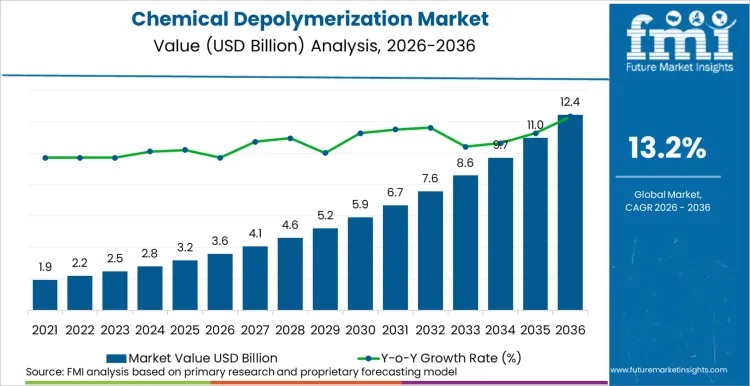
The chemical depolymerization market grows from USD 3.6B in 2026 to USD 12.4B by 2036, led by food-grade plastics demand.
NEWARK, DE, UNITED STATES, January 22, 2026 /EINPresswire.com/ -- Global Market Overview: A Shift Toward Advanced Circularity
The Chemical Depolymerization Market is entering a decisive growth phase as industries confront the technical limits of mechanical recycling. In 2026, global spending on chemical depolymerization is estimated at USD 3.6 billion, and it is forecast to reach USD 12.4 billion by 2036, expanding at a CAGR of 13.2%. This growth is driven by the need to convert complex, colored, and contaminated plastic waste into high-purity feedstock suitable for food-contact, textile, and engineering polymer applications.
Unlike conventional recycling, chemical depolymerization breaks polymers down into monomers or purified intermediates. These outputs can be reintroduced into polymerization processes, meeting virgin-equivalent specifications. As brand owners commit to closed-loop targets, acceptance rules are increasingly defined by polymer type coverage, contaminant tolerance, and audited mass-balance accounting rather than by recycling volume alone.
Request For Sample Report | Customize Report | Purchase Full Report –
https://www.futuremarketinsights.com/reports/sample/rep-gb-31712
Market Growth Trajectory and Value Outlook
The market has already expanded significantly, rising from approximately USD 1.9 billion in 2021 to USD 3.6 billion in 2026 as multilayer and difficult-to-recycle plastics enter chemical recycling routes. According to projections:
- Market value reaches around USD 5.9 billion by 2030
- Crosses USD 8.6 billion by 2033
- Approaches USD 11.0 billion by 2035
- Climbs to USD 12.4 billion by 2036
This growth reflects broader regulatory acceptance of chemically recycled feedstocks in primary applications, particularly food and beverage packaging.
Why Food and Beverage Packaging Leads Demand
Food and beverage packaging accounts for about 39% of total demand, anchoring most capacity commitments in the chemical depolymerization market. Entry into this segment requires:
- Tight control of color, odor, and migration limits
- Consistent intrinsic viscosity rebuilding
- Documented contaminant removal and audit readiness
Because qualification costs are high, once a depolymerization route is approved for food-contact use, it tends to remain in operation over extended cycles. This dynamic drives long-term offtake contracts rather than spot transactions, stabilizing revenue streams for technology providers.
Process Landscape: Why Glycolysis and Methanolysis Dominate
By process type, glycolysis and methanolysis together represent roughly 33% of market share. These routes are preferred because they:
- Efficiently return polyesters to defined monomers or intermediates
- Support closed-loop, food-grade and textile applications
- Offer controllable impurity profiles and stable yields
Other processes such as solvolysis and hydrolysis serve more heterogeneous waste streams but involve higher purification intensity. Once selected, process routes shape reactor design, separation systems, permitting, and certification, making later changes costly and time-consuming.
Regional Growth Hotspots
Growth in the chemical depolymerization market is global, with notable regional differences:
- India (15.2% CAGR): Driven by expanding recycling infrastructure, regulatory mandates, and rising polymer demand
- China (14.8% CAGR): Supported by large-scale urban recycling programs and industrial polymer production
- United States (12.6% CAGR): Fueled by corporate sustainability commitments and adoption of advanced recycling for high-value polymers
- Germany (12.0% CAGR): Shaped by regulatory pressure and industrial recycling integration
- Japan (10.4% CAGR): Focused on process efficiency, quality control, and compliance
These markets emphasize long-term integration of depolymerization within polymer supply chains rather than standalone recycling projects.
Competitive Environment and Strategic Positioning
Key players operating in the chemical depolymerization market include BASF, JEPLAN, Eastman, Loop Industries, GEM, Wankai New Materials, Teijin, and Mitsubishi Chemical Group. Competitive differentiation is based on:
- Reproducible monomer quality
- Conversion yield stability
- Regulatory and food-contact acceptance
- Technical support during scale-up and integration
Early alignment with brand sustainability roadmaps and regulatory frameworks often determines long-term market position, as approved processes are referenced in certification files and brand disclosures.
Constraints Slowing Capacity Expansion
Despite strong demand, capacity additions remain measured. Key constraints include feedstock variability, integration complexity with downstream purification and polymerization units, and lengthy brand qualification cycles. These factors make chemical depolymerization a governance and risk-management decision rather than a simple throughput-driven recycling choice.
Outlook: From Recycling Option to Manufacturing Input
Looking ahead to 2036, the chemical depolymerization market is expected to benefit from broader material coverage, higher plant utilization, and longer offtake contracts. As mechanical recycling reaches its limits, chemical depolymerization is emerging as a strategic manufacturing input that enables high-specification, circular polymer production at scale.
Related Reports
Precipitated Silica Market- https://www.futuremarketinsights.com/reports/precipitated-silica-market
Lithium and Lithium Ion Battery Electrolyte Market- https://www.futuremarketinsights.com/reports/lithium-and-lithium-ion-battery-electrolytes-market
Fiberglass Market- https://www.futuremarketinsights.com/reports/fiberglass-market
Have a specific Requirements and Need Assistant on Report Pricing or Limited Budget please contact us - sales@futuremarketinsights.com
About Future Market Insights (FMI)
Future Market Insights, Inc. (FMI) is an ESOMAR-certified, ISO 9001:2015 market research and consulting organization, trusted by Fortune 500 clients and global enterprises. With operations in the U.S., UK, India, and Dubai, FMI provides data-backed insights and strategic intelligence across 30+ industries and 1200 markets worldwide.
Contact Us:
Future Market Insights Inc.
Christiana Corporate, 200 Continental Drive,
Suite 401, Newark, Delaware - 19713, USA
T: +1-347-918-3531
Why FMI: https://www.futuremarketinsights.com/why-fmi
For Sales Enquiries: sales@futuremarketinsights.com
Website: https://www.futuremarketinsights.com
LinkedIn| Twitter| Blogs | YouTube
Sudip Saha
Future Market Insights Inc.
+1 347-918-3531
email us here
Legal Disclaimer:
EIN Presswire provides this news content "as is" without warranty of any kind. We do not accept any responsibility or liability for the accuracy, content, images, videos, licenses, completeness, legality, or reliability of the information contained in this article. If you have any complaints or copyright issues related to this article, kindly contact the author above.
